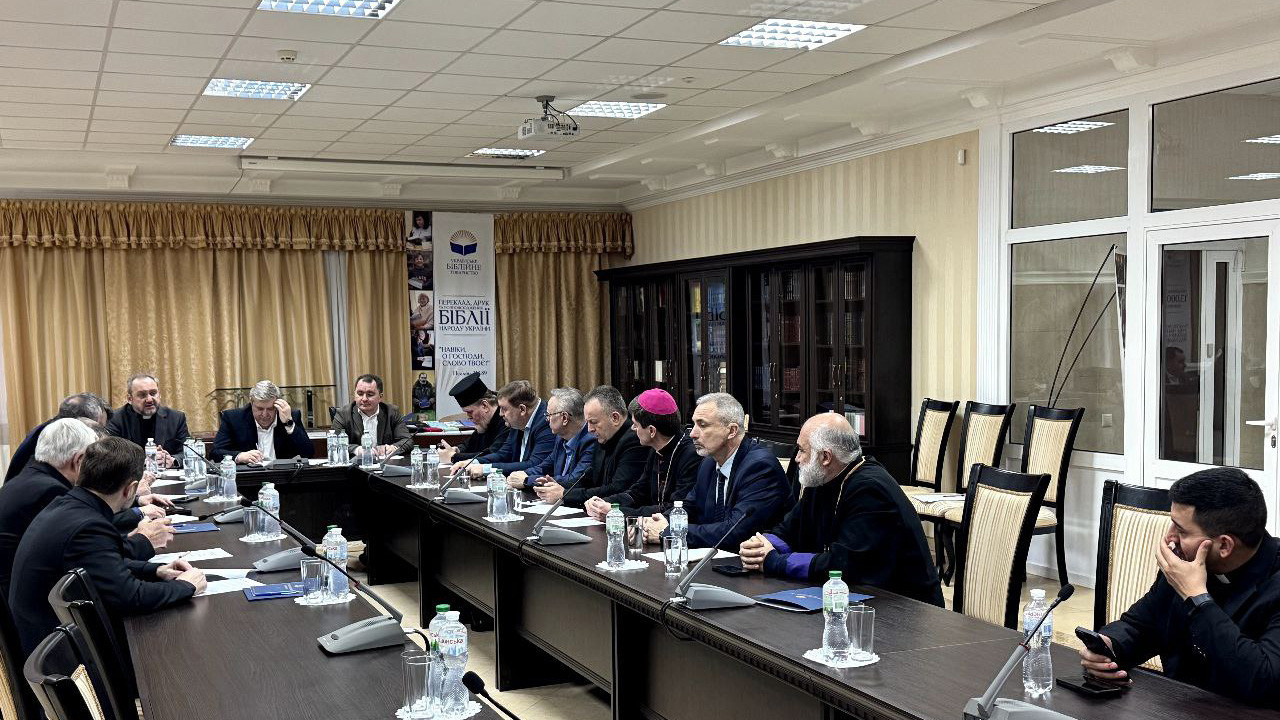
On 17 December 2025, a meeting of the Council of Christian Churches of Ukraine (the Council of Churches) was held in Kyiv under the chairmanship of Anatoliy Kozachok, Senior Bishop of the Ukrainian Pentecostal Church. During the meeting, the results of the current year were summarized, a Christmas Message was adopted, and a number of activities for 2026 were planned. The meeting took place at the Bible House of the Ukrainian Bible Society.
Following an opening address and the prayer “Our Father,” the participants analyzed the results of the Council of Churches’ activities. Particular attention was given to the Ukrainian Christian Movement (UCM), which was launched in April of this year at a joint meeting of the Council of Churches and representatives of Christian civil society organizations. Throughout 2025, the UCM Coordination Council was formed, comprising representatives of cluster-based Christian civil society communities of Ukraine. Guided by the main directions (vectors) of joint efforts aimed at the spiritual renewal of the Ukrainian people and the transformation of Ukraine, the UCM Coordination Council developed proposals for holding the Forum of the Ukrainian Christian Movement next year, as well as for organizing events dedicated to the anniversary of the publication of the Ostroh Bible—the first complete printed edition of the Bible in Ukraine and Eastern Europe and one of the most outstanding monuments of Ukrainian history.
As a result of the discussion, the Council of Churches agreed to hold the aforementioned UCM events in 2026, as well as to develop and adopt a statement of the Ukrainian Christian Movement addressing the danger of the ideology of the “Russian world” and the practice of its implementation.
Taking into account the war, the state of society and the economy, and the prospects for Ukraine’s post-war recovery, the Council of Churches also separately considered initiatives aimed at protecting life, children, and the family in Ukraine and developed relevant proposals. Following the discussion, the Council of Churches approved proposals to be submitted to the relevant state authorities regarding the formation of state policy on the protection of children in the field of education.
Christian religious leaders adopted a Christmas greeting from the Council of Christian Churches of Ukraine and recorded it in the format of a video address.
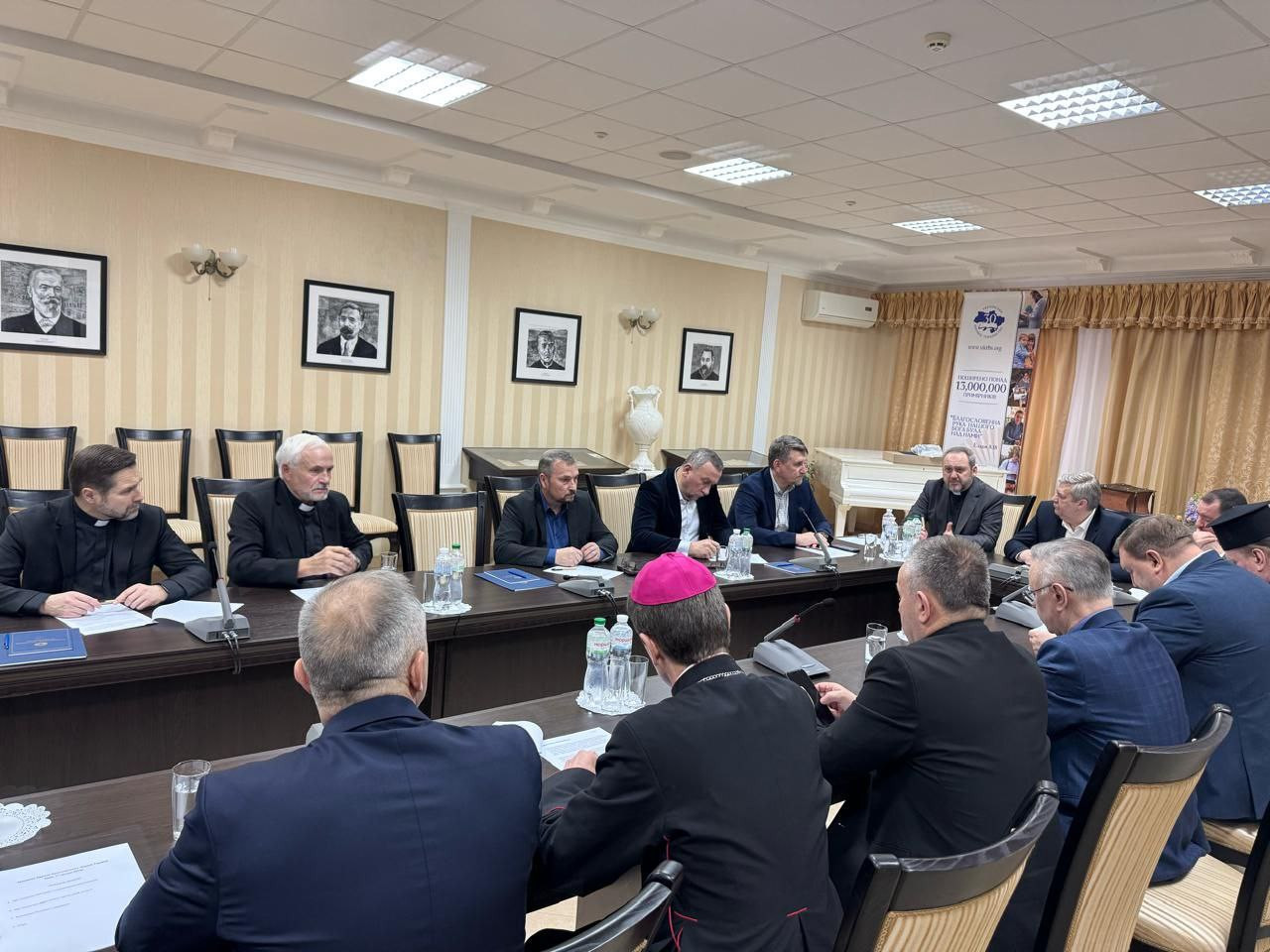
The meeting of the Council of Christian Churches of Ukraine was attended by: the Chair of the Council of Churches, Senior Bishop of the Ukrainian Pentecostal Church Anatoliy Kozachok; Metropolitan of Bila Tserkva of the Orthodox Church of Ukraine Yevstratiy (Zoria); Bishop of the Roman Catholic Church in Ukraine Vitaliy Kryvytskyi; Head of the All-Ukrainian Union of Churches of Evangelical Christians-Baptists, Bishop Valerii Antoniuk; Mitred Archpriest of the Ukrainian Greek Catholic Church Oleksa Petriv; Bishop of the Seventh-day Adventist Church in Ukraine Roman Prodaniuk; Senior Bishop of the Ukrainian Evangelical Church Oleksandr Zaitsev; Senior Bishop of the Ukrainian Christian Evangelical Church Leonid Padun; Head of the Brotherhood of Independent Churches and Missions of Evangelical Christians-Baptists of Ukraine, Pastor Mykola Rozhniatovskyi; Head of the Ukrainian Diocese of the Armenian Apostolic Church Markos Hovhannisyan; Secretary of the Synod of the Ukrainian Lutheran Church Igor Rudzik; Chairman of the Board of the Institute for Religious Freedom Oleksandr Zaiets, as well as other religious leaders.
Background Information
The Ostroh Bible (1581) is the first complete printed edition of all the books of Holy Scripture in the Church Slavonic language and an outstanding monument of Ukrainian and world printing. It was printed at the Ostroh Printing House by Ivan Fedorov with the financial support and patronage of Prince Kostiantyn-Vasyl Ostrozkyi. The work was completed on 12 July 1580, and the entire print run was released on 12 August 1581. The Ostroh Bible contains 1,256 pages. According to various estimates, the print run ranged from 1,500 to 2,500 copies, about 350 of which have survived to the present day. The edition became the canonical text for the entire Orthodox world for many centuries, and its text formed the basis for many subsequent editions.